Gateway WHV Production 00: An Introduction
Hello, and welcome! This initial blog post exists to provide a summary and synopsis of my upcoming web platform project, Gateway Working Holiday: New Zealand. I plan to publish a series of these posts with the intent documenting the entirety of the project, all the way from pre-production, to completion. In writing these entries, I will be able to share my insights and design approach, whilst also discussing what goes according to plan, what doesn’t, and which of my initial concepts and plans are shaped by and/or make it through the production process.
So, what exactly is this project, and what is its scope? Here is the pitch from my Design Brief:
Gateway to Working Holiday New Zealand is a web-based digital platform, aimed at travellers who plan to visit New Zealand on a Working Holiday Visa. This project aims to provide the essential and relevant information for their trip: covering all aspects of the user’s journey from Consideration → Planning → Arrival → Settlement → Travel & Work → Beyond - serving as a digital platform that provides end-to-end assistance for applicants of the Working Holiday Program in New Zealand. The service will deliver structured content with the intent of guiding users through the entire timeline of their trip, covering actionable resources such as job-finding tools, accommodation guides, location-based recommendations, vehicle purchase walkthroughs, travel and camping tips, administration checklists, and more. My goal is to provide a helpful service, designed to minimise the friction faced by travellers, as well as alleviate decision fatigue and potential trip delays/cancellations. Delivery methods for this product would be an intuitively designed website with a high standard of UX/UI sensibilities in mind.
Why choose New Zealand, you may ask? Well, the answer is simple: NZ is a highly sought after destination for travelers of all ages - it is known for its world class nature, is safe, and its locals are warm and welcoming. It is also particularly popular amongst young adults, and for this audience, Aotearoa is a common destination for those that want to embark on a Working Holiday, a special type of visa that is only available for citizens of eligible countries between the age of 18-30. Also known as a youth mobility agreement, the Working Holiday Visa, or WHV, is a bilateral accord between two select nations, where citizens from one respective nation, are permitted to live in the other for up to one year, for the purposes of cultural exchange. According to Immigration NZ’s 2025 statistics alone, 40,000 people entered the country on this visa, with a large array of reasons as to why, whether it be to sample living abroad, go on an extended holiday, seek out temporary work in a new environment, or to use it as a stepping stone towards finding a new permanent place to call home.
The prospect of such an adventure is an exciting one, but there’s a lot to consider for people, especially young adults who may have just finished school or Uni, may not have much experience living outside their comfort zone, are likely budget conscious due to their young age, and would suddenly need to navigate an entirely governmental, cultural, and social system to what they’re used to back home. My target users are in the age range between 18-35 years old, with an 50/50 split ratio of male/female. They are digitally literate, proficient in using the Web for research purposes, but are anxious; overwhelmed by the wealth of information online, the logistics of travelling abroad, and are facing uncertainty regarding the consequences of lifestyle change. Some of their usual behaviours include Googling, scrolling Instagram, watching YouTube videos, and joining Facebook and Reddit communities - in order to browse, inform themselves, ask questions, and seek inspiration. Their personality types include people who are curious and adventurous, but not spontaneous enough to disregard pre-planning. The user’s goal is to try new experiences, gain independence, pursue avenues of self growth, and step outside their comfort zone. As a seasoned young traveller, and as someone who has had the benefit of undertaken this specific journey, I am well-aware of the looming difficulties that they may face. Being a core member of the target audience, allows me to be well-equipped in providing a compelling and competitive solution for the target customer.
There’s a lot of administration processes involved when moving abroad, and this combined with the differences with local Kiwi norms, could be overwhelming for any would-be traveler. Despite this, there are currently limited options online which completely cover the entire process in a digestible way. Some common pain points include:
• Fragmented information between platforms
• A lack of practical guidance based on lived experiences
• Cognitive overload due to a decentralisation of resources
This is a niche that I want to fill with my project - with Gateway WHV serving as a nexus for all working holiday-related data points, and an invaluable sidekick for anyone embarking on this journey. By positioning my platform as a comprehensive and user-friendly resource, and avoiding the pitfalls of competitors which are fractured or general sources of information, I want to strike a balance between actionable information, alongside celebrating the lived experiences of its users - enabling everyone to confidently plan, arrive, work, and explore.
In terms of competitors, there exists a francophone centric website for travellers called pvtistes.net, which serves as a general resource for people interested in applying for WHVs globally. Although it is designed with Francophone nationals in mind, it does have limited English language support and provides some general information for users from other nationalities. Pvtistes.net is focused on delivering a broad, generalist offering that covers multiple target destinations. I aim for my product to fill a similar but more focused niche, which hosts a specialised pool of resources tailored for the target destination. As no such website currently exists, my product could find a competitive advantage by delivering a product that is equally parts useful, as it is friction less to engage with, designed to guide users through all pain points, provide encouragement, and highlight the joys of travel. Other competitive alternatives are generally in the form of Reddit communities, travel blogs, Facebook groups, and YouTube creators – all of which are informal and decentralised in nature. As these alternatives are on existing community platforms and are inconsistent, this leaves me with the opportunity to produce my very own community platform.
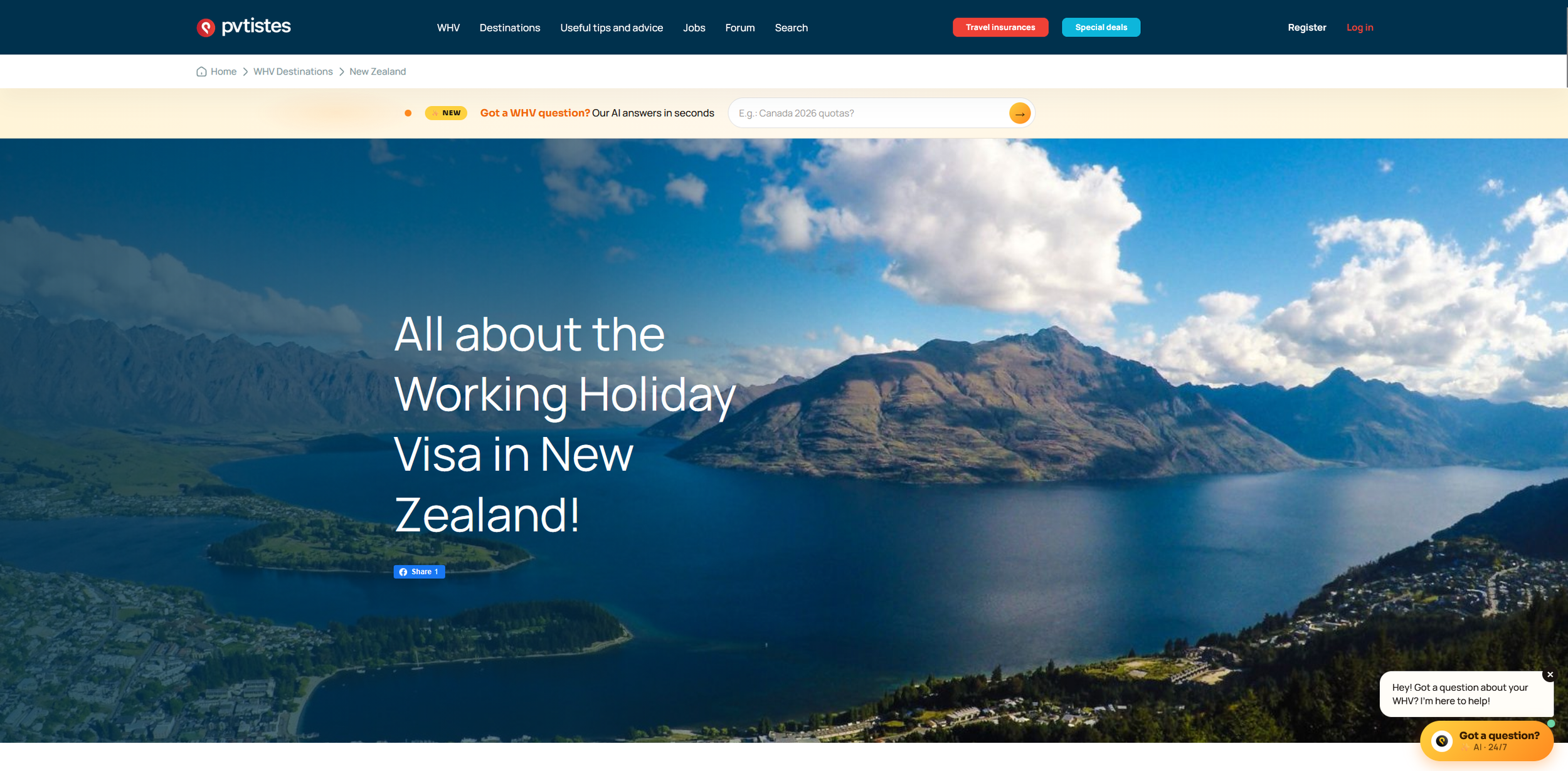
The pvtistes.net page dedicated to NZ
It’s a useful resource, however due to its nature of covering a plethora of destinations under one site, its content is somewhat general, and the websites design can be considered ‘dry’. I can capitalise on this by providing a richer content offering, with a web design that shows a distinct personality and playfulness.
On my project page, I outlined some of the key goals that I have in designing this website:
Build my UI/UX Capabilities
I want to design and develop an intuitive user experience, as this is a field that I am passionate about and would like to explore further in a professional capacity. The goal is for the website to intuitively guide users through the entire timeline of their trip, so that no matter what point they are at in terms of their journey, they are able to easily find resources relevant to them. Staple content such as location-based job and accommodation recommendations, vehicle purchase guides, travel and camping tips, are just some of the categories that should be readily available upon first clicking onto the home page.
Make it Stand Out
It begins with an idea, but having a unique brand personality is also required to make the project memorable. While it’s absolutely key for the UI to be easy to navigate, it is just as important to make the website stand out from competitors. Walking that tight-rope between offering a service that is clean and modern, whilst also having a unique personality, is one of my pillars for WHV Gateway. The branding has to be able to tell its own story.
It’s about the People
Community! Travel is all about the travelers, and no two journeys are the same. Community-friendly features are exciting, and they promote engagement. Gateway Working Holiday needs to have a hook that makes people excited to come back to the website time and time again. This could be a news letter, discussion forums, interactable features, highlighted user stories, or something else entirely. As I work on this project, this will continue to be front of mind, as I work to implement it in a manner that complements my designer ethos.
At this stage, I have a clear user problem that needs to be solved, as well as my personal goal of expanding my UI/UX ability, but my primary exercise before starting to work on the actual website is to further develop my branding in order to “Make it Stand Out” more. Feedback from my peers told me that my concept is strong, and that angling my content to structure around the user’s journey, covering planning, arrival, settlement, travel, and work - helps to make a large amount of information less overwhelming. My pre-production prototypes are modern and user-friendly but lacks a personality to make it “pop” with unique elements to allow me to stand out from the crowd of other NZ-centric travel websites, so my main goal for my next blog post is to work on my branding so that my platform will be able to have its unique voice. I hope to see you there in the next chapter. For now, I’ll leave one of my mock ups below as a teaser, in order to give an idea of what I’m building upon.
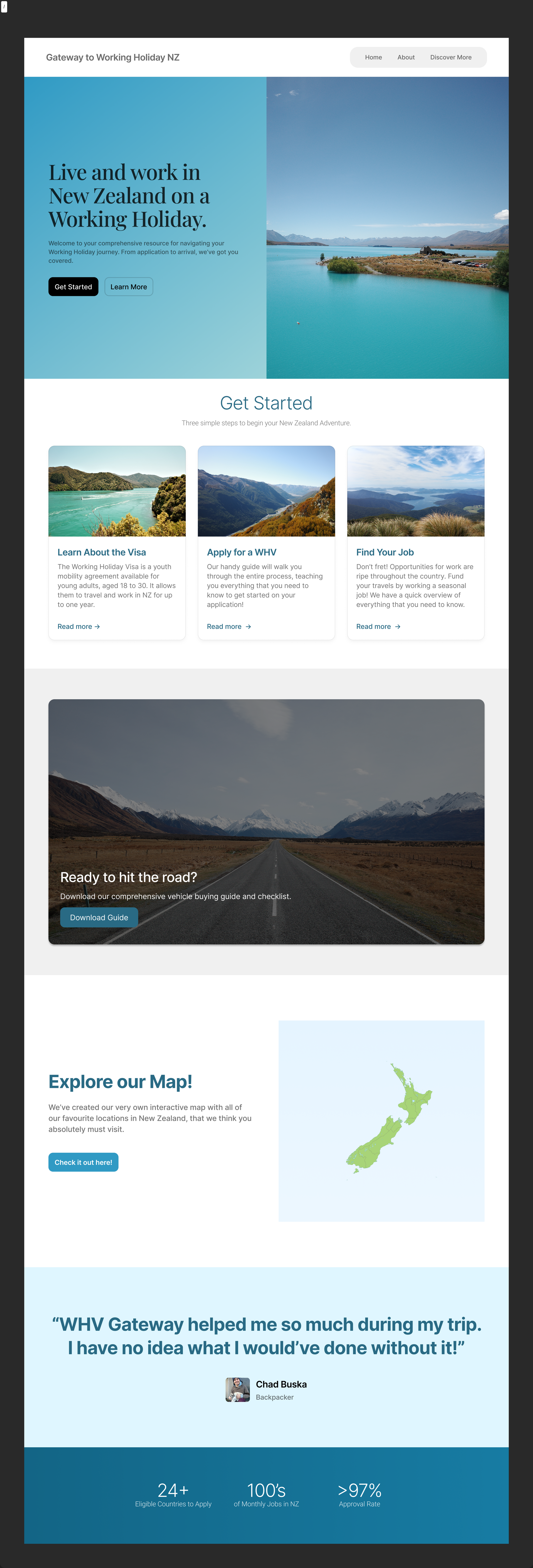
My third mock up for a potential landing page. This one doesn’t use my chosen colour palette, but it has some nice ideas that I could use in my final version!
Michael
